


Maths
At Oreston Community Academy, we believe that every child can achieve success in mathematics. We are committed to providing a high-quality mathematics education that develops confident, resilient and capable mathematicians who can apply their knowledge and skills across the curriculum and in everyday life.
Our mathematics curriculum is designed to:
- Develop fluency in mathematical knowledge and skills.
- Foster deep conceptual understanding through a mastery approach.
- Encourage reasoning, problem solving and mathematical discussion.
- Build children's confidence, perseverance and positive attitudes towards mathematics.
- Ensure all pupils make sustained progress regardless of their starting points.
- Prepare pupils with the mathematical foundations required for the next stage of their education and beyond.
Through carefully sequenced learning, children develop the ability to think mathematically, articulate their reasoning and make connections between different mathematical concepts.
Implementation
At Oreston, we use Power Maths (recommended by the DFE) as a basis of our Maths lessons from Foundation to Year 6. At the heart of this programme is the idea that all children can achieve and be successful Mathematicians with the right growth mindset. This mastery whole-class approach empowers every child to succeed and progress together through interactive lessons and practical activities, providing small, cumulative steps to build a solid foundation of deep mathematical understanding.
Power Maths uses the Teaching for Mastery model as illustrated. This has been developed by the NCETM
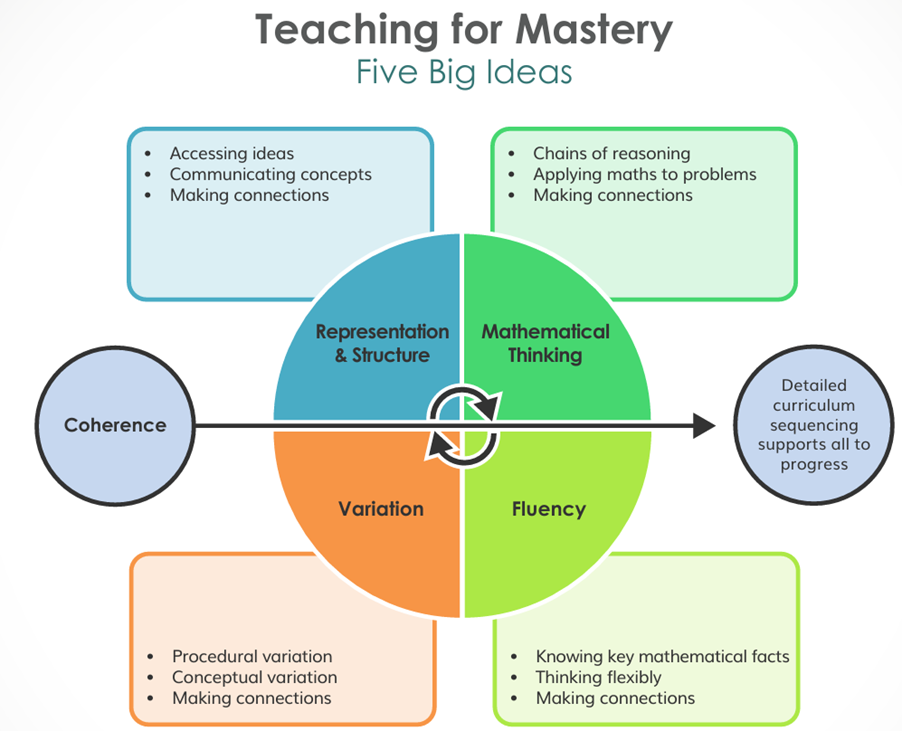
Lessons follow a progressive sequence that enables children to:
- Explore mathematical concepts through discussion and discovery.
- Develop understanding using the Concrete-Pictorial-Abstract (CPA) approach.
- Practise and apply skills independently.
- Reason mathematically and explain their thinking.
- Reflect upon and evaluate their understanding.
The CPA approach supports children in developing deep understanding:
Concrete
Children manipulate physical resources and practical equipment to explore mathematical concepts and solve problems.
Pictorial
Children use visual representations such as diagrams, models and drawings to demonstrate and deepen understanding.
Abstract
Children apply their knowledge through the use of mathematical symbols, notation and formal methods.
Teachers use high-quality questioning, modelling and assessment throughout lessons to identify misconceptions and provide timely support. Additional pre-teaching and same-day intervention opportunities ensure that all pupils are able to access the curriculum and progress successfully alongside their peers. [Maths | Word]
To strengthen retention and fluency, pupils regularly revisit previously taught concepts through retrieval practice and arithmetic activities. In Key Stage 2, children further develop multiplication fluency through Times Table Rock Stars, supporting success in the Year 4 Multiplication Tables Check. [Maths | Word]
Assessment is an integral part of teaching and learning. Teachers use ongoing formative assessment, pupil discussions and recorded work to inform next steps. Summative assessments are used at key points throughout the year to monitor attainment, progress and curriculum coverage. [Maths | Word]
Early Years Foundation Stage (EYFS)
In the Early Years Foundation Stage, mathematics is taught through a combination of carefully planned adult-led learning, practical exploration and purposeful play. Mathematical development is embedded throughout the learning environment, allowing children to apply their understanding in meaningful contexts.
We use the NCETM Mastering Number Programme to support the development of strong number sense and secure understanding of number from the earliest stages. Children are taught to:
- Subitise and recognise small quantities without counting.
- Develop a deep understanding of numbers to 10 and beyond.
- Recognise, create and extend patterns.
- Compare quantities and explore relationships between numbers.
- Develop confidence when using mathematical vocabulary.
- Solve practical mathematical problems through exploration and discussion.
Through hands-on experiences and high-quality mathematical interactions, children build secure foundations that support future success in mathematics.
Impact
The impact of our mathematics curriculum is demonstrated through confident learners who can reason, problem solve and apply their mathematical understanding across a range of contexts.
Children at Oreston Community Academy:
- Develop secure mathematical knowledge and understanding over time.
- Demonstrate increasing fluency and accuracy in calculation.
- Explain their thinking using appropriate mathematical language.
- Approach challenges with resilience and confidence.
- Make connections between different areas of mathematics.
- Achieve outcomes that prepare them well for the next stage of their education.
Monitoring through lesson visits, work scrutiny, pupil discussions and assessment information enables leaders to evaluate the effectiveness of mathematics provision and ensure continual improvement. As a result, pupils develop a strong foundation in mathematics and leave our school equipped with the skills, knowledge and confidence needed for future success.